Guide with original data
How to buy a house at a Spanish property auction as a foreigner
Thinking of buying a cheap house in Spain at auction? It can be done from abroad, but the rules are strict, the paperwork is in Spanish and some homes are cheap for a reason. This guide covers each step, with our own figures on what is on sale today.
By Alejandro Juan, founder of Subastas de Viviendas · Published · data as of 10 November 2026 at 00:42 (Madrid time) · 12 min read · Leer en español
Key figures
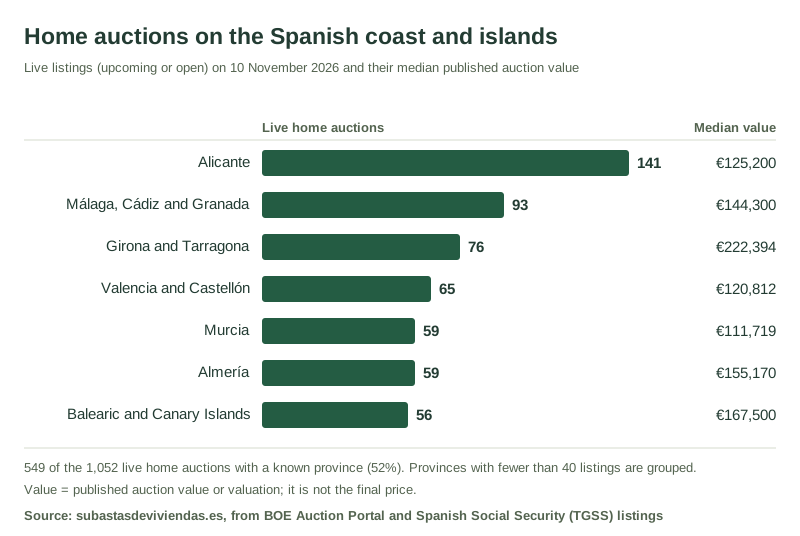
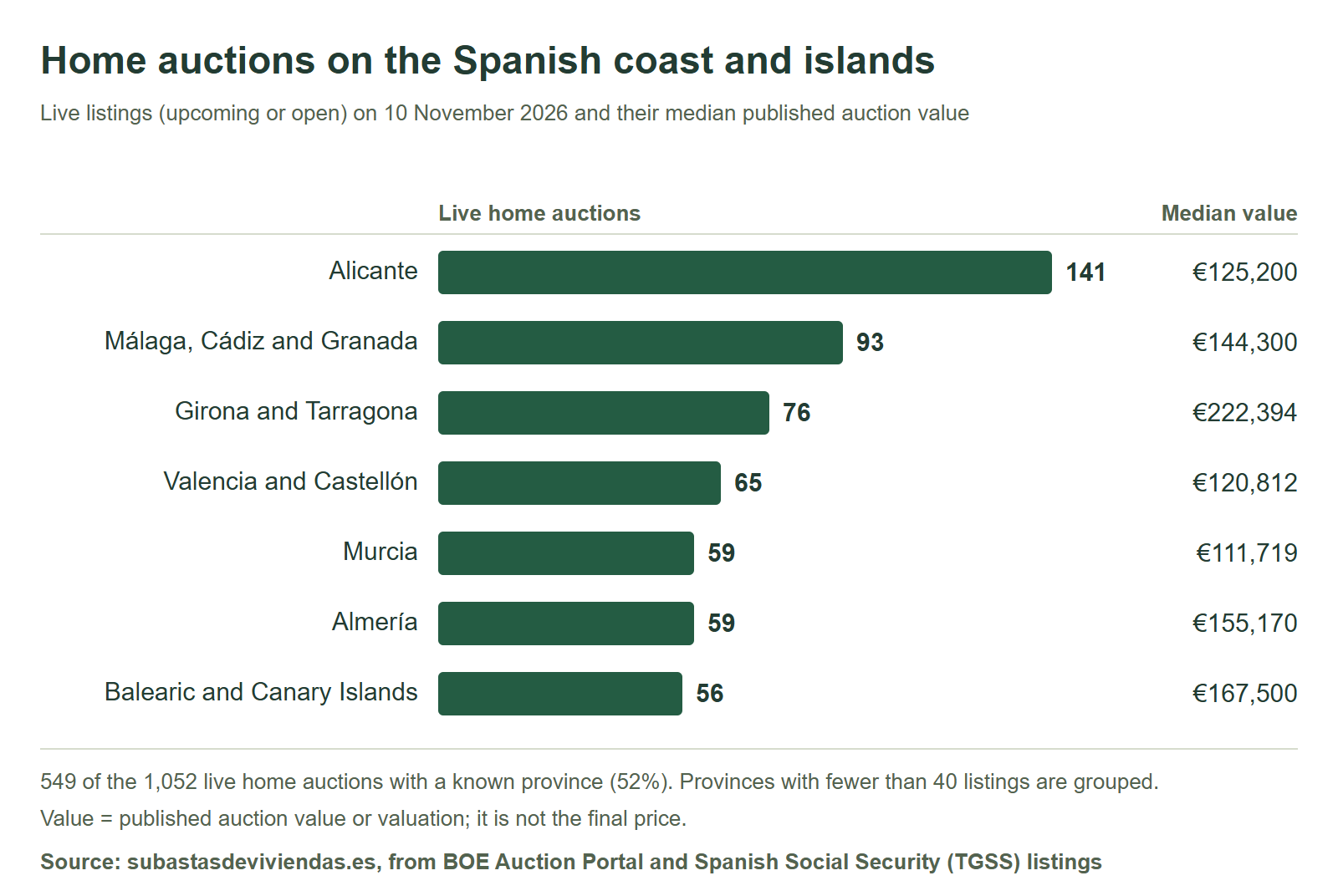
- 1,069 homes were up for auction in Spain on the cut-off date; 549 of the 1,052 with a known province (52%) are in the coastal and island provinces most popular with foreign buyers.
- 321 live home auctions (30%) have a published value under €100,000, and 133 are under €50,000.
- In 3,732 finished BOE home auctions, 31% got no bids at all; where there were bids, the median highest bid was 72% of the auction value.
What is on sale right now
On 10 November 2026 at 00:42 our catalogue held 1,069 home listings (flats, houses, duplexes, penthouses and studios) whose auction was upcoming or open: 876 from the BOE Auction Portal and 193 from Spanish Social Security. The median published auction value was €146,230. New ones keep coming: from April to October 2026, an average of 978 home auction listings a month opened for bidding on the BOE portal alone (from 344 in August, when the courts slow down, to 1,434 in June).
| Area | Live home auctions | Median auction value | Under €100,000 | Under €50,000 |
|---|---|---|---|---|
| Alicante | 141 | €125,200 | 36 | 10 |
| Valencia and Castellón | 65 | €120,812 | 24 | 12 |
| Murcia | 59 | €111,719 | 26 | 5 |
| Almería | 59 | €155,170 | 7 | 1 |
| Málaga, Cádiz and Granada | 93 | €144,300 | 31 | 14 |
| Girona and Tarragona | 76 | €222,394 | 9 | 4 |
| Balearic and Canary Islands | 56 | €167,500 | 13 | 1 |
| All coastal areas above | 549 | — | 146 | 47 |
| All of Spain | 1,069 | €146,230 | 321 | 133 |
We only publish a figure when it rests on at least 40 listings, so provinces with fewer are grouped with their neighbours. The cheapest coastal areas by median value are Murcia (€111,719), followed by Valencia–Castellón and Alicante; Girona and Tarragona are the most expensive. A low value is not a bargain on its own: it often reflects size, condition, location or the fact that only a share of the property is for sale. Browse the live list in the auction search or by province.
What happens when the auction closes
Our study of 3,732 BOE home-auction results (closing between September 2025 and October 2026) shows that 1,168 of them (31%) received no bids. Where someone did bid, the median highest bid was 72% of the auction value, and the single most common range was 70–75% (302 results): bidders aim for the 70% threshold explained below. The highest bid is not always the final award price.
| Province | Results | No bids | Median highest bid / value |
|---|---|---|---|
| Alicante | 321 | 29% | 76% |
| Valencia | 227 | 24% | 75% |
| Murcia | 221 | 37% | 70% |
| Almería | 217 | 46% | 70% |
| Tarragona | 182 | 40% | 63% |
| Málaga | 123 | 11% | 92% |
| Castellón | 94 | 34% | 66% |
| Cádiz | 82 | 33% | 59% |
| Girona | 82 | 40% | 73% |
| Granada | 76 | 36% | 66% |
| Las Palmas | 73 | 14% | 84% |
| Balearic Islands | 60 | 7% | 99% |
The pattern matters for foreign buyers: in the places they know best, competition is stronger. In the Balearic Islands and Málaga very few auctions went without bids and the median highest bid was close to the full value, while in Almería and Tarragona many homes got no bids at all. Santa Cruz de Tenerife had fewer than 40 results and is not shown on its own.
1. Get a NIE
The NIE (Número de Identidad de Extranjero) is the tax and identification number every foreigner needs to buy property in Spain. You need it to obtain a Spanish digital certificate or Cl@ve, to pay the transfer tax and to register the property in your name. You can apply at a Spanish consulate in your country or, in Spain, at an immigration office or police station. Allow several weeks: appointments are scarce in the coastal provinces, and the 20-day bidding window of an auction is too short to start then.
Buying a home no longer brings a residence permit: the so-called golden visa for property investment was abolished with effect from 3 April 2025 (Organic Law 1/2025). Buying at auction gives you the property, not the right to live in Spain.
2. A digital certificate or Cl@ve — or a representative
Judicial, notarial and Tax Agency auctions take place online on the BOE Auction Portal. To bid you must register on the portal and identify yourself with a recognised electronic certificate (for example the one issued by the FNMT, the Spanish mint) or with Cl@ve, the Spanish public e-identity system. Both are linked to your NIE.
If you cannot obtain them, a lawyer or court representative (procurador) can bid for you through the portal's representation option, with a power of attorney. A power granted outside Spain usually needs an apostille and a sworn translation, so arrange it well before the auction.
3. A Spanish bank account and your funds
Deposits for BOE auctions are paid only through the portal, from an account held by the bidder (or on which the bidder is an authorised representative) at a bank that collaborates with the Tax Agency's payment gateway. In practice that means a Spanish bank account. Accounts that need several signatures cannot be used.
Move the money in good time. International transfers can take days, and Spanish banks will ask where large sums come from under anti-money-laundering rules. Remember that the rest of the price is due within weeks of the auction (see step 6), so mortgage pre-approval is rarely fast enough: most auction buyers pay with their own funds.
4. The deposit: 20% or 5%
To bid in a judicial auction you must lodge a deposit: 20% of the auction value (minimum €1,000) if the proceedings began on or after 3 April 2025 (art. 669.1 of the Civil Procedure Act, LEC, as amended by Organic Law 1/2025), or 5% in earlier proceedings. The exact amount appears on each auction notice. At the median value of today's listings (€146,230), a 20% deposit would be about €29,246.
If you do not win, the deposit is returned, unless you asked for it to be held so that your bid can be considered if the winner fails to pay. Social Security and Tax Agency auctions set their own deposit rules in each notice.
5. How bidding and the extension work
A BOE auction stays open for 20 calendar days, and bids are placed online at any time in that window. To stop last-second sniping, a judicial auction does not close until one hour has passed since the last bid that beat the previous best, even if that extends the 20 days, for a maximum of 24 hours (art. 649.2 LEC). Tax Agency auctions follow a similar one-hour rule (art. 104 of the General Collection Regulation).
6. The 70% rule and 40 days to pay
If the best bid reaches 70% of the auction value, the court approves the sale and the winner must pay the difference between the deposit and the price within 40 days (art. 670.1 LEC). Miss that deadline and you lose the deposit.
If the best bid is below 70%, the sale is not automatic (art. 670.4 LEC). The debtor has 10 days to bring a third party offering more; then the creditor may ask to take the property itself for 70% of the value or for the amount owed (if that is above 60% and above the best bid). Otherwise the court may approve your bid if it exceeds 50% of the value or covers the amount claimed; if not, it decides in view of the circumstances. Lower bids can therefore take weeks to resolve and can still be rejected.
7. Charges, the nota simple and occupancy
Before bidding, get a nota simple, the land-registry extract that shows the owner, mortgages and other charges. You can request it online from the Land Registry. In a judicial auction, the bidder accepts that charges ranking ahead of the creditor's claim remain in place (art. 668.3 LEC): the price you pay does not cancel them. Unpaid community fees for the current year and the previous three (art. 9.1.e of the Horizontal Property Act) and unpaid local property tax (IBI) can also fall on the new owner.
Occupancy is the other big unknown. You usually cannot visit the inside. In our study of 8,460 auction listings, only 9% stated whether the home was occupied, and about three in four of those that did said it was. A court can order possession, but that takes time and legal costs. Read our guide to charges and occupancy.
8. Transfer tax and other costs
Buying a resale home in Spain is subject to transfer tax (ITP), at a rate set by each region — typically between 6% and 10%, with higher brackets for more expensive homes in some regions. The tax base for auction purchases has its own rules, so ask a tax adviser in that region before you set your maximum bid. Add land-registry fees, any legal or translation fees, repairs, and any debts or charges that remain. As a non-resident owner you will also file an annual non-resident income tax return for the property. Our budget calculator and guide to costs and taxes help you build the full figure.
9. Social Security and Tax Agency auctions
Not every auction is a court auction. Spanish Social Security (TGSS) sells seized homes on its own electronic office under the Social Security General Collection Regulation (RD 1415/2004), and the Tax Agency (AEAT) auctions seized property on the BOE portal under the General Collection Regulation (RD 939/2005). These administrative auctions do not follow the Civil Procedure Act: the 70% rule, the judicial deposit and the payment deadlines above do not apply as such, and each notice sets its own deposit, minimum price and conditions. The TGSS official information warns that prior charges ranking ahead remain there too. Read our comparison of BOE and Social Security auctions.
Methodology
Methodology and how to cite
- Live listings: read-only query of our own database on 10 November 2026 at 00:42(Madrid time). We count home listings (flat, house, chalet, duplex, penthouse, studio) from the BOE Auction Portal and Spanish Social Security whose auction is upcoming or open. A proceeding with several lots counts each lot. Download the query.
- Value is the published auction value (BOE) or valuation (Social Security); 5 listings without a value are left out of the medians and price bands. 17 listings have no province and are only counted in the national total.
- Results: aggregates from our study of BOE home auctions dated 12 October 2026. The highest bid is not necessarily the award price.
- No figure rests on fewer than 40 listings or results. The data contain no names, addresses or other personal details.
How to cite: “Subastas de Viviendas, live home auctions in Spain, data as of 10 November 2026 at 00:42”, with a link to this page. You may reproduce the figures and the chart with that citation.
- Civil Procedure Act (Ley de Enjuiciamiento Civil), consolidated text (external site, opens in a new tab)
- Organic Law 1/2025 (deposit change and transitional rules) (external site, opens in a new tab)
- BOE Auction Portal: user help (external site, opens in a new tab)
- Tax Agency (AEAT): auction deposits FAQ (external site, opens in a new tab)
- Spanish Social Security (TGSS): auctions of seized assets (external site, opens in a new tab)
- General Collection Regulation (Tax Agency), RD 939/2005 (external site, opens in a new tab)
- General Collection Regulation (Social Security), RD 1415/2004 (external site, opens in a new tab)
- Land Registry: request a nota simple (external site, opens in a new tab)
- Cl@ve: Spanish public e-identity (external site, opens in a new tab)
Scope and professional advice
This guide is general information, not legal, tax or financial advice. Rules change and every auction notice has its own conditions; check the official notice and, before bidding, consult a lawyer and a tax adviser in Spain. Many source documents are in Spanish; this English text is not a certified translation.